Excerpt
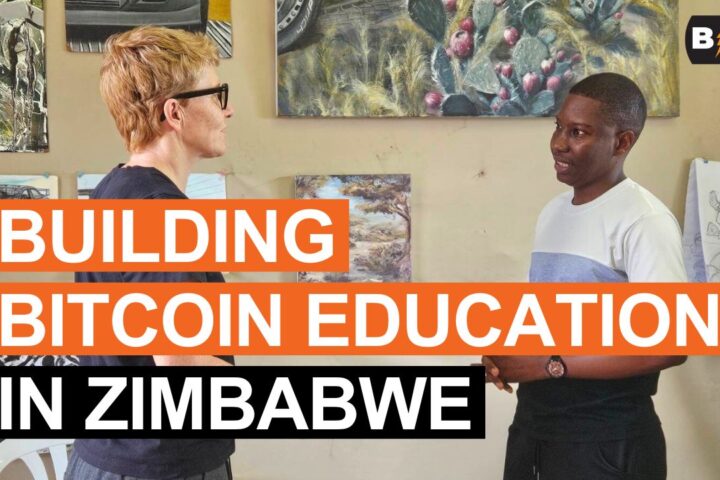
I interview Ethan, a Zimbabwean farmer who uses solar energy to mine Bitcoin. He shares how he integrates Bitcoin into his farm, from mining to selling produce, and why it matters in Zimbabwe’s unstable economy.
Transcript
We’re visiting Ethan today. Ethan is a farmer here in Bulawayo and the special thing about him is that he’s also a Bitcoiner and he has been mining bitcoin for a couple of years now with solar. So he has free electricity and uses it to mine bitcoin. We’re going to talk with him about the use cases for bitcoin in Zimbabwe and also how he tries to integrate bitcoin into his farming. Hi Ethan. Hi, Ethan. First time we meet. Definitely. It’s been a long time, but finally we get to meet on HomeTurf. Yeah, your HomeTurf and my like, I like it very much, turf. Yes. Because like a couple of years ago, you contacted me. I remember and you told me you’re a farmer in Zimbabwe, but you’re actually living in the UK. Yes. So it’s a remote farm. Yes. And you have solar power and you would like to try bitcoin mining and that’s how it started. Yes. That was that was a trigger moment that led to everything else up until this point. How so? Well, every the reason I contacted you at that time, I wasn’t sure if bitcoin mining could actually work. And I thought, okay, let me reach out to someone who’s in the industry who has experience, who knows other people that may be able to give me that experience I need and you know, purchase some miners, got some miners, tested it out and it worked. Simply put, in a nutshell. And then we were lucky to find a guy who offered to send you some used miners and you put them also here. Yeah. And in the first years, but I don’t know how long it was. It started three years ago, I think. Right? Yeah. So the story behind that was, I can’t remember, I can’t remember how I got in touch with the gentleman, but you gave me a name. Yeah. Yeah. And you said, yeah. And I said, I have someone. Yeah. And so basically, what had happened is he had some miners, he used to mine in the capital. And he said, Hey, I got some miners. Do you want them? I hear you trialing out in Harare, in Bulawayo, sorry. And, you know, if you want them, they’re here. I can send them to you. I no longer use them. And he sent them down to me. I trial them out. They came with all the cables. They came with all the plugs ready to go. And we set up in a garage. We got the electricals up to standard. We got the battery up to the equivalent or necessary requirement to run them for 24 hours. And that’s how our journey started. So it was an interesting journey, but we definitely learned how to set up miners, how to run miners. We understood the energy requirements of the miners and what was really possible, which was the goal. You were testing it here, you mean? Yes, yes. On the farm. On the farm in Bulawayo, in the garage. And, you know, if you remember well, we also did the recording, the podcast on it. Yeah, I can remember. And it had a lot of traffic. I got a lot of invites, a lot of different Twitter spaces, kind of the conversations. And yeah, it’s, you know, we proved it could be done. Yeah, it was proof of work in a way. So, back at that time, I remember you told me how much profit you made a week. How much was it? It was about $25 | 28,649 sats to $30 | 34,378 sats per week. Which is great for some baboons, you know. It is, it is. What was great about that particular event was proving that it could mine was the first step. Proving that you could automatically get the payment every day. I think it was midnight every day, because that’s when the transaction cashed out. And proving it could go across borders, which was even better, because you know how difficult that particular part is, especially from a monetary perspective. So it ticked a lot of boxes and I was sold after that. And been able to harness all this abundant sun that we have here. And I think that’s the interesting point, because a lot of people don’t know that mining with solar power actually works. And I remember you had enough batteries to run the five miners back then, right? Yeah, we had the batteries is the good part of the story. And then we subsequently lost them, you know, burglary, etc. But we’ve, you know, we’ve moved beyond that. We then acquired additional batteries, but not as great as the previous ones, because the prices of lithium spiked. And simply put, we just couldn’t get back to that position. Because we had to focus on security and hardening our farm to make sure that did not reoccur. Yeah. So, I mean, globally, as a Zimbabwean, please tell our audience why Bitcoin is so special and such a good fit actually for Zimbabwe, for people in Zimbabwe. Yeah. Well, from my personal perspective, I think there’s a couple of reasons. The first being, if you look back the last five years, you need to ask yourself how many variations or different currencies have we had, versions of the same currency that we had, you know, but coin survived them all. That would be my personal milestone. And then of all those currencies that didn’t survive, but coin survived, and it’s out performed them in every metric possible. You can and then, you know, if you then fast forward as well now, you can use it for cross border transactions. You can you can even find people locally in that are willing to buy it off you because they want to do foreign transactions. And, you know, that would be the utility, that particular utility in terms of those three milestones. I think the other one would be potentially in the future finding people that were willing to accept it to trade goods, because at least the prices would be fixed. You wouldn’t have to be scurrying to the shop if you’ve got X amount of ZIG. And, you know, it gets debased or devalued, because Bitcoin holds its value. And it’s probably less volatile than the ZIG itself. Absolutely. Yeah. So comparatively, it’s, you know, there’s no competition really. It’s a great tool. But what do you say about USDT? I heard a lot of people here are using USDT, because they want the properties of a cryptocurrency, like being able to send it easily and cheaply in and out of the country. And with USDT, one, you don’t have volatility in the same way you have it in Bitcoin. And two, you have predictable fees. So like with Tether, when you send it, you know exactly how much fees you pay with Bitcoin and with Lightning, if you have your own Lightning channels, then you don’t really know. Yeah. And so these are reasons why people here use USDT. Why would you not use USDT? It’s a good question. There’s probably not a lot of reasons I could argue around it. But if you had to compare anything compared to the ZIG or what we currently have here, everything would probably be better. That’s the problem we have. So if you take USDT and you compare it to the ZIG, it’s better. You take Bitcoin, you compare it to the ZIG, it’s better. You take the Zambian Quacha, you compare it to the ZIG, it’s better. So using the ZIG as your commonality, it creates difficulty in finding out what’s really better. Yeah. And I think the goal is actually your goal, what you want to achieve with a currency is the guiding rule for what you use. Because I know you have been following and using Bitcoin for a long time. So you built the trust that it goes up over time. And I think it’s mostly people who are very new, who are afraid of this volatility, or maybe businesses who don’t want to deal with the ups and downs. So they take USDT because it’s like the US dollar here. And everyone wants the US dollar. Exactly. I mean, you’ve got to find what makes sense to you individually as a person. You know, I have a surplus of fruits, I have a surplus of honey, I have a surplus of fish. And I’m willing to accept Bitcoin because I know the properties of Bitcoin. And because I’ve been in the space, you know, say, what is it now? This is probably my second cycle halving in that sense. So I know I can look back and say, this is temporary. You know, when I was looking at the chart you put up yesterday about Bitcoin’s volatility, I thought to myself, that looks like my heart rate when I’m hiking. Right? That’s what I thought. In the end you survive. Exactly. And everything’s okay at the end, right? The journey kind of ends and you’re like, oh, I did it. So if you’re comfortable with that, and then if you had to overlay the ZIG on that, it would probably be like that, you know, at the bottom. So comparatively, it’s always better. But then coming back to my original point, the value is if you have a product and you’re based here and you can exchange, you know, your economic energy for Bitcoin, whatever product you have, you know, at least it’s predictable. You know that you’re getting something of value. You know, you can transact outside of your borders and you’re not locked into a particular system, so to speak. Yeah. And in comparison to the USDT, no one can take it away from you if you’re self-custody. Absolutely. And that’s the main reason for me to use Bitcoin and not USDT. Exactly. So I mean, there are many more reasons, of course, but one of those. Yeah. I think after seeing how our session went with some of the, you know, the team, the people that came to the meetup, yes, I’m going to ask you this question yesterday. My message to them would be, you know, you can ask as many questions as you want about Bitcoin, but you have to go out, purchase it, hold it, observe it, answer those questions for yourself over a period of longer than just six months, longer than a year, longer than two. Because if you don’t do that, you’re going to keep coming back to those same questions. I don’t ask questions much anymore because I know what it looks like. It’s just hiking. I would definitely also add for me what makes you much more financially literate and educated and savvy is to earn it and spend it. Because then over time you will also see how to manage your budget. You know, even if you’re a business, then you know, OK, how much do I need to save for the long term as a reserve for my company? How much can I now use to pay my employees, for instance? And I think it makes you much more literate. I don’t know what the word is, savvy and practical in using your finances. And so I actually don’t get people who really just hold it and say, I hold it until I’m dead. So why do you hold it in the first case? Because by just holding it, you take in a way all the utility has. Exactly. Holding is also utility and saving, but spending it creates a circular economy in a way. And the money also, if more people receive it and use it, then that’s also a network effect. It is. Absolutely. I mean, you’ve walked around the farm. You’ve seen that everything is useful, even a fence is useful. You throw granadillas on it. It becomes useful. You build a pond, you put fish in, becomes useful. We grow the feed for the fish. It becomes useful. So everything has its utility. We then sell all that stuff that we’ve made useful for Bitcoin and it’s also useful. So that’s just the cycle or the system I see in my mind. So I think anybody out there that wants to transact abroad or wants to lock in their economic future should use it to do just that. But isn’t it also especially for the people in the diaspora something that they could think of? Absolutely. You know, I had this idea that if everybody from the diaspora that sends funds back home took that 2% transaction fee, you know, if there was a centralized company that did it and used Bitcoin to auto convert to USD, that 2% could be, you know, a deduction, say a diaspora Bitcoin reserve. And that could certainly help for the future to fund the recovery of, you know, this great nation, so to speak. That would be great. So you’re basically searching for buyers who buy the produce you have for Bitcoin? Absolutely. So tell us a little bit about what are the advantages for businesses in Zimbabwe to use Bitcoin? Well, I think the advantage is you know that it’s going to be there tomorrow when you wake up. It’s not going to get debased, which is the second part. You know nobody can take it away from you. And you know you can transact across international borders in order to acquire stuff you need for your business. So really, if you look at those four things I’ve just mentioned, your business will survive because there’s no disruption by forces outside of your control. Simply put, that’s what I would say. And next step, so if you have customers who pay you in Bitcoin, what would you do then with the Bitcoin for the farm or for the workers? What’s your idea about that? Well, we’ve got a few things going on. We empower our workers to do their own projects within the farm. We’ve got a chicken project as well, which I’ve totally given them, so it’s technically a partnership. So we use all the funding from that to reinvest so they can continuously scale. So the idea behind that is we take a portion of it and we bank it in Bitcoin to ensure that there is something there for them in the future because there’s no stable pensionable system here. That’s very important, yeah. Absolutely. There’s nothing. You know, first and foremost. And then everything else that we get from the projects that are focused on the farm activities, we use that to reinvest in the farm itself. So whether that’s a year or two years from now, continually scale those ideas because the more we scale those ideas, the more Bitcoin we earn and the more Bitcoin we can use to invest in the farm. What’s the plan with the miners? Because since your batteries are gone, sadly, you can’t mine at the moment 24 hours a day. So what’s the plan there? So we’ve still got our miners, which is the good part. They’re very valuable. So in that sense, the idea is we had a bit of an experiment over the last two weeks where we wanted to use the miners to control the environmental temperature because we’re in the agriculture business breeding, or should I say, growing tilapia, and to control the internal heat, the ambient temperature. That’s the word I was looking for, ambient temperature, as well as the water temperature. Because if we can do that using miners with the same energy, we’d use any way to heat the water and to keep the lights on. It just means we’re also getting Bitcoin simultaneously to keep in the water warm and the ambient temperature warm. But that requires to your point energy. So you first need to get back the infrastructure to be able to mine again. And also I would think as the miners are now at least three years old, I mean they are older because you have them since three years and they were used already. Maybe someone of our listeners wants to donate some miners. It can be used machines. It’s really not a problem. And Ethan also knows how to get them into the country, logistically. And that’s that thing. So I would really love to see you mining again. What we now have here, we had a donor donating five-bit access. Correct, yeah. And we are setting them up today. We will see. Maybe you are lucky like those other guys who found a Bitcoin, a block, I mean. I absolutely hope so. I got five chances every day. Yeah, five chances exactly. Yeah, and then speaking of aquaculture, tell us a little bit about that project and how it helps in a school that you visited, actually. Yes. So simply put, the school are dependent on donations. Donations are not sustainable for the long term. That’s to feed the kids, to keep the infrastructure at the school running, to ensure that they can just take over. If you take the students quarterly school fees, which is $50 | 57,297 sats every three months, you know, if you calculate that over years, not a lot of money. They’ve got 37 teachers, 583 kids. So with the aquaculture, the idea simply put is to put them in a position where they have every six months, at least $24 | 27,503 sats to $32,000 | 0.37 BTC to be able to do those things without having to rely on, you know, school fees to keep the toilets clean, keep the water taken over. So that’s the simple vision. So we’ve done the first part, which is we’ve put the pool in, we’ve populated with fish, we’ve put in the life support systems with solar, VFDs, filtration systems, home built, totally manageable from a local perspective, replaceable. And to keep improving on that so we can scale it from 10 tons every six months to 20 tons every six months at $3 | 3,438 sats a cage. And we’re willing to accept Bitcoin, of course. It’s great, yeah, because basically the school now has a project that gives them additional money every year, two times. Twice, yeah. I mean, more than the fees they receive, I think. Absolutely. If you look at 10 tons at $3 | 3,438 sats a cage, you’re looking at $33,000 | 0.38 BTC every six months. If we then take that to 20 tons, you double that amount. So that’s sufficient. They can do a lot of things. And the agreement I have with the school is, oh, we had with the school before we started was, if I do this, you don’t send anybody home that cannot pay their school fees, because you’re now able to do these particular things. So they agreed. Yeah, great work that you did there. And I hope the fish, the first harvest will be ending two months. Two months. 10,000 fish? How many? So if there’s anyone out there that wants 10 tons of fish. Local fish, actually, right? Yes, yes, nylotica tilapia. They call them Zambezi brim for lack of a better term. Okay. Yeah. So recently you started beekeeping and producing honey? Yes. So we’ve been doing beekeeping now for approximately just over two years. So it’s been a bit of a label of love, you know, in terms of looking after the bees, getting swarms. It’s actually biodynamic beekeeping, which means if the bees want to leave, if, you know, the colony gets too big, we let them leave because we just, yeah, there’s two ways of doing it. You can lock them in or you can just let them be. So we let them be. Pardon the pun. But the idea there is we keep the bees here, we get some honey from it. They pollinate the local farmers, fruits, vegetables, etc. Because they yield goes up. They don’t know that. The bees, you mean? Well, the farmers. Yes, all the farmers. And really, if somebody wants to buy the honey, we only accept Bitcoin for it. We don’t take fear for it. For everyone else that is in the know, like yourself, etc., that’s in our circle of trust, we give them honey. Okay, nice. Yeah, thank you for the honey. And it’s pure. So you basically just take the… Just the honey? Just the honey, yeah. That’s it. Because I was told there are a lot of people selling honey, which is filled up with water a little bit. Yes, yes. And things like that. So that’s great, yeah. So if you’re in for honey here in Zimbabwe, here is someone who is producing and accepting Bitcoin. Absolutely. We’re here. And also you live in Airbnb here, right? Yes, in the cottage we’re in here. So it’s available around the clock throughout the year, with the exception of maybe two months a year, but it’s available most times. So who wants to live in a farm for a time in Zimbabwe and play in Bitcoin? Exactly. This is the place. Learn about beekeeping. We’ve even got bee suits if they want to don a bee suit and… Or help with the mining setup, bringing miners, whatever. Absolutely. Most welcome. Great. Yeah, thank you Anita. That’s all there is.